Hestia
Ἑστία
Ringkasan
Hestia adalah dewi perawan perapian dan rumah dalam mitologi Yunani, putri sulung Cronus dan Rhea, yang menerima bagian pertama dari setiap kurban.
Hestia is the virgin Greek goddess of the hearth and home, eldest daughter of Cronus and Rhea, who received the first share of every sacrifice.
Kisah dan tradisi
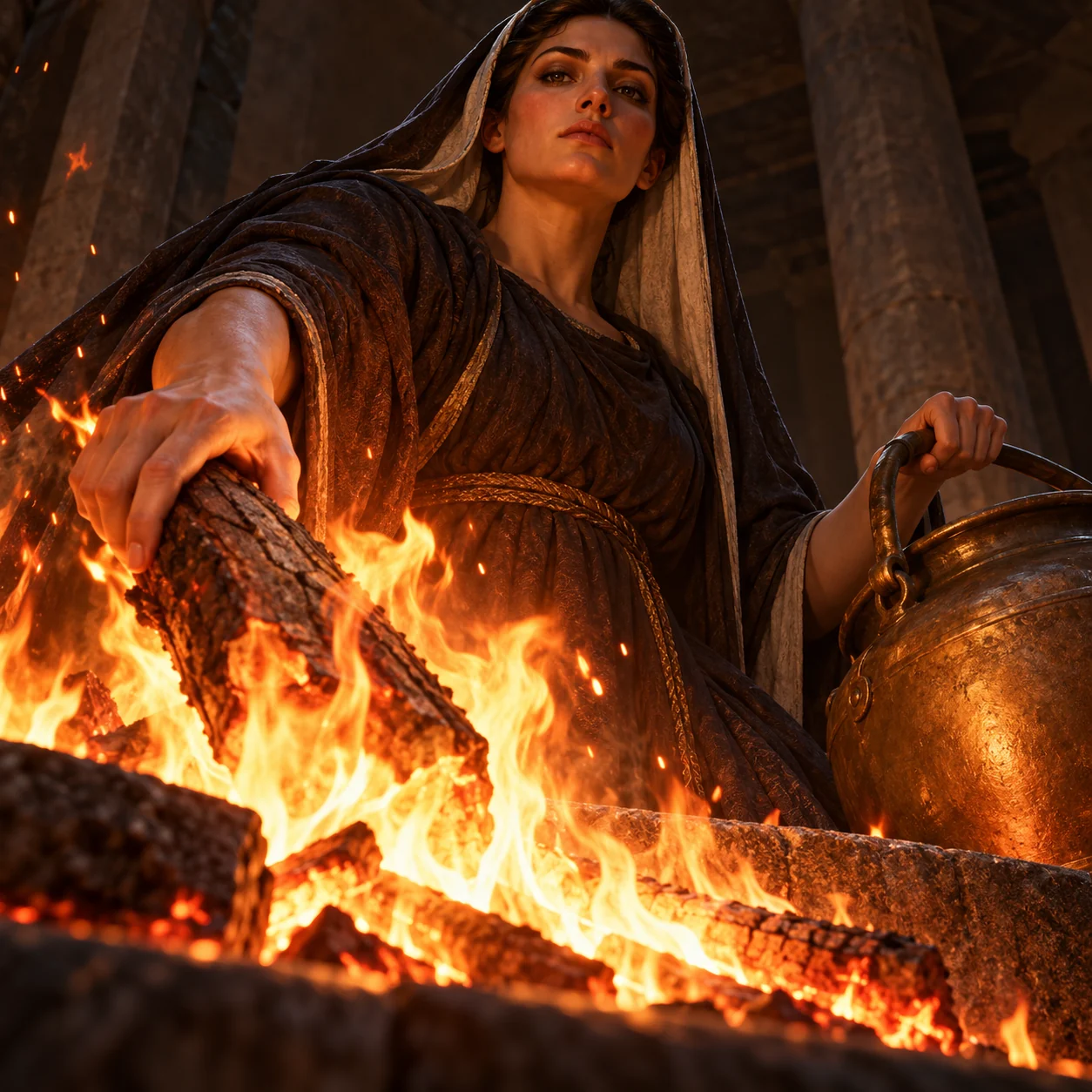
Hestia adalah dewi perawan perapian, rumah, dan keramahtamahan dalam kepercayaan Yunani. Dalam mitos ia putri sulung Cronus dan Rhea, ditelan ayahnya saat lahir lalu dimuntahkan kembali oleh Zeus. Sebagai pelindung keluarga dan komunitas politik, persembahan dibuat bagi Hestia di perapian setiap rumah dan di perapian umum kota. Bangsa Romawi mengenalnya sebagai Vesta. Hestia menerima kurban lebih dulu daripada dewa lain, juga persembahan anggur pertama dan terakhir pada setiap pesta, dan biasanya disebut pertama dalam doa dan sumpah. Menurut mitos, Zeus memberinya kehormatan itu ketika ia bersumpah tetap perawan, meskipun Apollo, Poseidon, dan Priapus mendekatinya. Perapian melambangkan jantung dan jiwa rumah tangga, dan kaitannya dengan perapian menghubungkan Hestia dengan keramahtamahan serta perlindungan tamu. Di kota, ia terutama dikaitkan dengan prytaneion dan bouleuterion, pusat simbolis pemerintahan setempat. Hestia tidak punya mitologi yang menonjol: ia digambarkan sebagai dewi senior yang menjauh dari urusan para dewa, dan ia satu-satunya yang tidak ikut serangan gagal para dewa Olimpus terhadap Zeus. Dalam sebagian daftar ia termasuk 12 dewa Olimpus, tetapi lebih umum tempatnya diisi Dionysos; dalam sebagian mitos ia sendiri menyerahkan tempat itu kepada Dionysos. Dalam seni ia biasanya digambarkan sebagai perempuan muda berkerudung dan berpakaian sederhana, sulit dibedakan dari dewi lain. Pemujaan umum Hestia sangat marak di Attica, dengan kultus penting di Piraeus, Eleusis, Halimos, dan Krokonidai. Imam dan imam perempuan yang khusus mengabdi kepadanya tampak lazim sejak masa Helenistik, dan pada masa Romawi, ketika ia dikenal sebagai Vesta, ia terus dipuja, misalnya di Ephesus. Setiap kali koloni baru didirikan, nyala api dari perapian umum Hestia di kota induk dibawa ke permukiman baru.
Hestia is the virgin Greek goddess of the hearth, home, and hospitality. In myth she is the eldest daughter of Cronus and Rhea, swallowed by her father at birth and later disgorged by Zeus. As protector of the family and political community, offerings were made to Hestia at the hearth in every home and at a city's public hearth. The Romans knew her as Vesta. Hestia received sacrifices before the other gods, as well as the first and last libations of wine at any feast, and was usually mentioned first in prayers and oaths. According to myth, Zeus gave her this honour when she swore to remain a virgin, despite the attentions of Apollo, Poseidon, and Priapus. The hearth symbolised the heart and soul of the household, and her link with the hearth tied Hestia to hospitality and the protection of guests. In the city her special place was the prytaneion and bouleuterion, the symbolic seat of local government. Hestia has no prominent mythology: she is presented as a senior goddess aloof from the affairs of the other gods, and alone among the goddesses she stayed out of the Olympians' unsuccessful assault on Zeus. Some lists count her among the 12 Olympians, though Dionysos more often fills that seat; some myths have her yield the seat to him herself. In art she is usually shown as a young woman, veiled and modestly dressed, and is hard to tell apart from other goddesses. Her public cult flourished above all in Attica, with notable cults at Piraeus, Eleusis, Halimos, and Krokonidai. Priests and priestesses specifically dedicated to her seem to have been common from the Hellenistic period, and in the Roman period, when she was known as Vesta, she continued to be worshipped, for example at Ephesus. Whenever a new colony was founded, a flame from Hestia's public hearth in the mother city was carried to the new settlement.
Konteks budaya
Perapian dipandang sebagai pusat suci kehidupan rumah tangga dan lambang jantung serta jiwa rumah tangga; Hestia dianggap pemberi kebahagiaan dan berkat rumah tangga, dan sumpah serta suaka pemohon dikaitkan dengan perapian. Kurban bagi Hestia berupa buah sulung, air, minyak, anggur, dan sapi berumur satu tahun, dan api perapiannya yang padam tidak boleh dinyalakan kembali dengan api biasa.
The hearth was seen as the sacred centre of domestic life and a symbol of the household's heart and soul; Hestia was regarded as the giver of domestic happiness and blessings, and oaths and the asylum of suppliants were tied to the hearth. Offerings to Hestia were first fruits, water, oil, wine, and one-year-old cows, and her hearth fire, if extinguished, could not be relit with ordinary fire.
Fakta utama
- Budaya / Culture
- Mitologi Yunani
- Kawasan / Region
- Eropa
- Era
- Named in Greek literature from Hesiod's Theogony (an epic of the 8th or 7th century BC according to Theoi) and worshipped into the Roman period
- Klasifikasi / Classification
- Deity
- Habitat
- Dwelling
- Kemampuan / Abilities
- Ranah: perapian dan api kurban, Ranah: rumah tangga dan keramahtamahan, Kehormatan menerima kurban pertama, Atribut: kerudung, dahan berbunga, dan ketel
Nama lain / Alternate names
Ἑστία, Histia, Prutanitis
Tahukah kamu? / Did you know?
Karena Hestia disebut pertama dalam doa dan sumpah, muncul ungkapan Yunani "mulai dari Hestia".
Because Hestia was named first in prayers and oaths, a Greek saying arose: 'to begin from Hestia.'