Hephaestus
Ringkasan
Hephaestus adalah dewa Olimpus dalam mitologi Yunani untuk api, pandai besi, dan kerajinan, yang menempa senjata, perhiasan, dan alat ajaib bagi para dewa.
Hephaestus is an Olympian god in Greek mythology of fire, smiths, and crafts, who forged weapons, jewellery, and marvellous devices for the gods.
Kisah dan tradisi
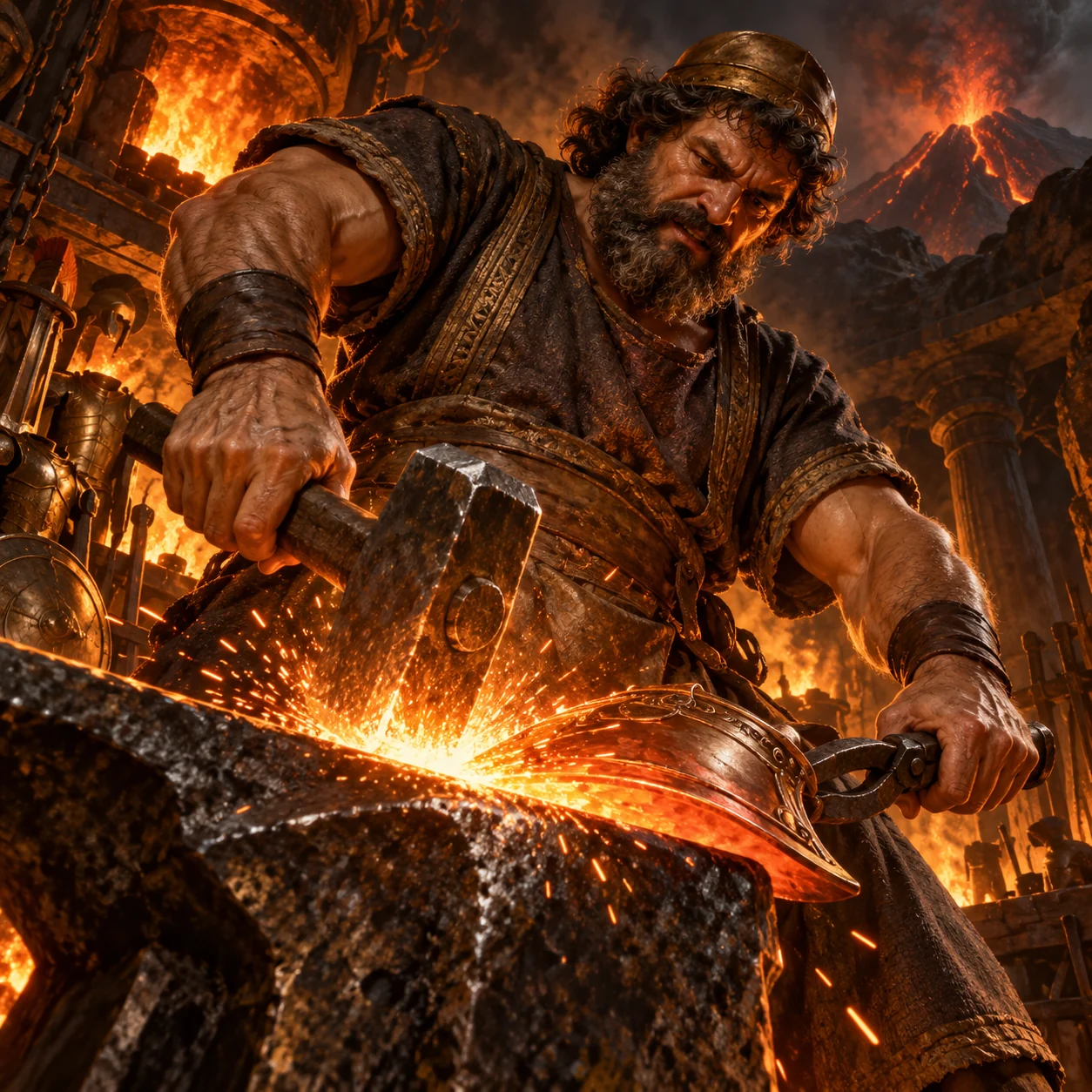
Hephaestus adalah dewa Olimpus untuk api, pandai besi, pengrajin, pengerjaan logam, pemahatan batu, dan seni patung. Ia adalah dewa api, terutama sebagai kekuatan alam di daerah vulkanik dan sebagai sarana dalam seni dan kerajinan. Dalam seni ia digambarkan sebagai lelaki berjanggut yang memegang palu dan penjepit, sering memakai topi pekerja dan menunggang bagal. Bengkelnya digambarkan berada di bawah gunung berapi seperti Gunung Etna; dalam Iliad ia memiliki rumah dari perunggu yang bertabur bintang. Para dewa Olimpus menerima buah karyanya: rumah, zirah, dan alat cerdik. Ia dikreditkan membuat tongkat kerajaan dan aegis Zeus serta helm Hermes, dan membentuk Pandora dari tanah liat. Ia juga membuat automaton, antara lain pelayan emas yang bisa berbicara, tripod berroda yang bergerak sendiri, dan Talos dari perunggu. Dalam Iliad, ia menempa perisai bagi Achilles dari perunggu, timah, emas, dan perak, dihias dengan bumi, langit, laut, matahari, dan bulan. Tradisi Homeros menyebut Hephaestus putra Zeus dan Hera, sedangkan tradisi lain menyebut Hera melahirkannya tanpa ayah. Ia dibuang dari Olimpus, menurut satu versi oleh Hera saat lahir dan menurut versi lain oleh Zeus, lalu mendarat di Lemnos dan dirawat Thetis dan Eurynome. Ia kemudian menjebak Hera dalam singgasana terkutuk; Dionysos membujuknya kembali ke Olimpus. Ia menikahi Aphrodite, yang kemudian terperangkap bersama Ares dalam jaring emas. Ia dipuja terutama di Athena dan Lemnos. Di Athena ia berbagi kuil dan festival dengan Athena, termasuk festival Chalkeia para pandai besi, sedangkan di Lemnos kota Hephaistia memiliki tempat suci untuknya. Ia dipercaya menyembuhkan lewat tanah Lemnos, dan bangsa Romawi menyamakannya dengan Vulcan.
Hephaestus is an Olympian god whose domains include fire, smiths, craftsmen, metalwork, stonemasonry, and sculpture. He is the god of fire, especially as a power of nature in volcanic districts and as a means in arts and crafts. In art he is a bearded man holding a hammer and tongs, often wearing a workman's hat and riding a mule. His workshop is described as lying beneath volcanoes such as Mount Etna; in the Iliad he has a house of bronze decked with stars. The Olympian gods received the fruits of his craft: houses, armour, and ingenious devices. He is credited with making the sceptre and aegis of Zeus and the helmet of Hermes, and with shaping Pandora from clay. He also made automatons, including gold maids who could speak, self-moving wheeled tripods, and bronze Talos. In the Iliad he forges a shield for Achilles from bronze, tin, gold, and silver, decorated with the earth, the heavens, the sea, the sun, and the moon. Homeric tradition names Hephaestus as the son of Zeus and Hera, while other traditions say Hera bore him without a father. He was cast out of Olympus, by Hera at birth in one version and by Zeus in another, landed on Lemnos, and was cared for by Thetis and Eurynome. He later trapped Hera in a cursed throne; Dionysos led him back to Olympus. He married Aphrodite, who was later trapped with Ares in a golden net. He was worshipped especially at Athens and Lemnos. At Athens he shared a temple and festivals with Athena, including the Chalkeia festival of the blacksmiths, while on Lemnos the city of Hephaistia had a sanctuary for him. Lemnian earth was believed to heal, and the Romans equated him with Vulcan.
Konteks budaya
Hephaestus dan Athena dipercaya mengajarkan manusia kerajinan yang memperindah hidup, sehingga manusia yang dulu tinggal di gua kini hidup damai di rumah sendiri menurut Himne Homerik 20. Kepincangannya mungkin cerminan kerasnya kondisi kerja pandai besi, menurut satu penafsiran, dan orang Yunani sering menaruh patung kecil mirip kurcaci sang dewa di dekat perapian. Asal-usulnya tidak jelas; ia mungkin berasal dari gagasan bahwa raja-raja awal juga harus menguasai kerajinan.
Hephaestus and Athena were believed to have taught men the crafts that embellish life, so that, according to Homeric Hymn 20, people now live peacefully in their own houses. His lameness may reflect the harsh working conditions of a blacksmith, according to one interpretation, and the Greeks often placed small dwarf-like statues of him near the hearth. His origins are obscure; he may derive from the idea that early kings should also master crafts.
Fakta utama
- Budaya / Culture
- Mitologi Yunani
- Kawasan / Region
- Eropa
- Klasifikasi / Classification
- Deity
- Kemampuan / Abilities
- Menempa logam dan senjata ilahi, Menciptakan automaton, Menggunakan api sebagai senjata, Menjebak dengan karya ciptaan, Penyembuhan lewat tanah Lemnos
Nama lain / Alternate names
Vulcan, Hephaistos, the lame one
Tahukah kamu? / Did you know?
Dalam Iliad, Hephaestus ditopang pelayan perempuan dari emas yang punya pengertian, bicara, dan tenaga, serta membuat tripod berroda emas yang bergerak sendiri ke pertemuan para dewa.
In the Iliad, Hephaestus is supported by golden handmaidens who have understanding, speech, and strength, and makes golden-wheeled tripods that move by themselves into the gathering of the gods.