Vayu
Ringkasan
Vayu adalah dewa angin Hindu dan utusan ilahi para dewa.
Vayu is the Hindu wind god and divine messenger of the gods.
Kisah dan tradisi
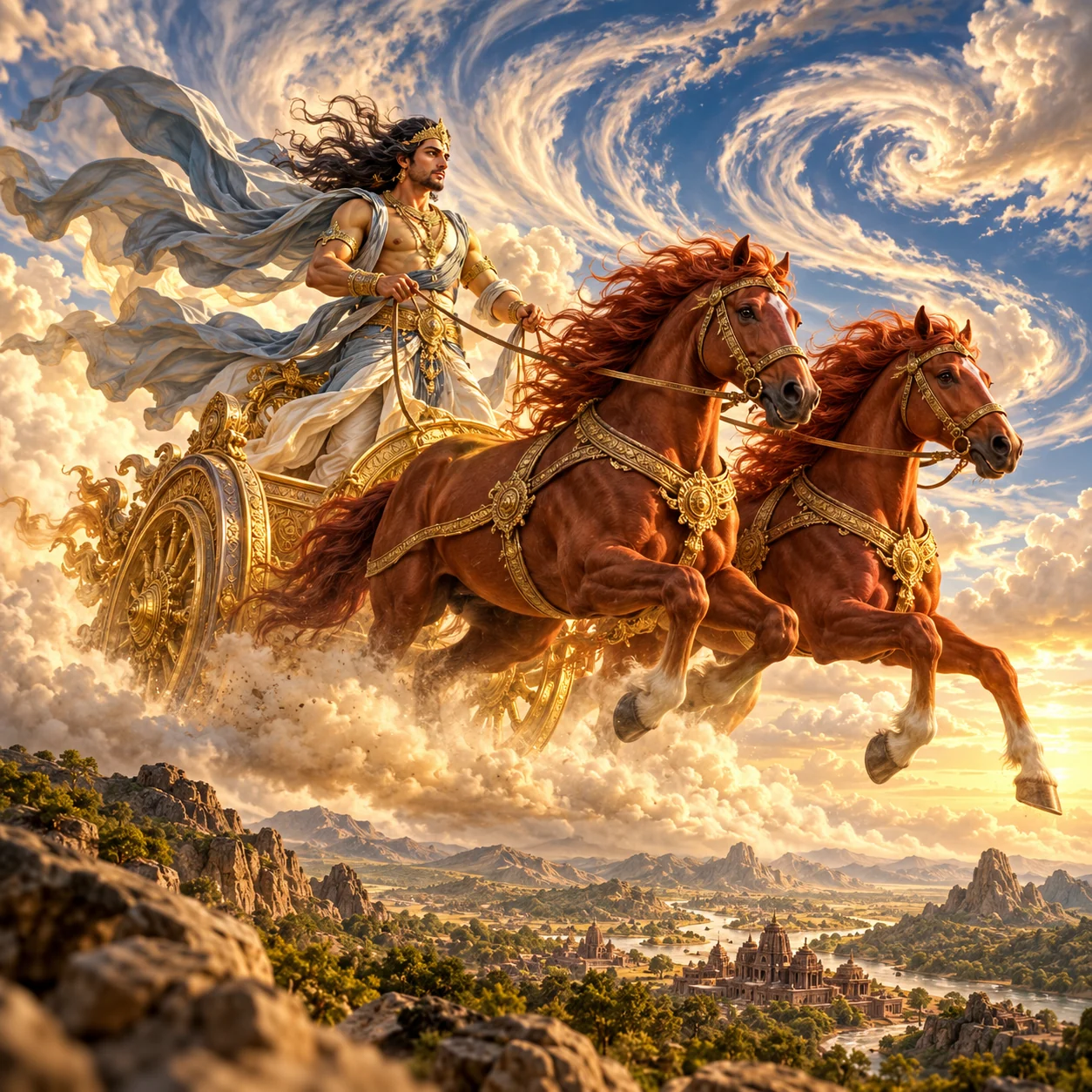
Vayu adalah dewa angin Hindu dan utusan ilahi para dewa. Nama lainnya termasuk Vata dan Pavana. Ia berhubungan erat dengan Indra dalam kitab Weda. Vayu adalah dewa pertama yang menerima soma dalam ritual, lalu ia dan Indra berbagi tegukan pertama mereka. Ia disebut lahir dari napas Vishvapurusha; dalam penuturan Mackenzie tentang Purusha, Indra dan Agni muncul dari mulutnya, sedangkan Vayu dari napasnya. Upanishad memujinya sebagai Prana, napas hidup dunia. Vayu dijelaskan sebagai peniup dan Prana sebagai napas kehidupan. Dalam Rigveda, Vayu dikaitkan dengan angin, dan para Marut digambarkan lahir dari perut Vayu. Rigveda menghubungkannya dengan kereta bercahaya yang ditarik kuda. Mackenzie mengutip himne yang menghubungkan Vayu dengan dua kuda merah pada kereta serta kawanan rusa. Rigveda 1.2 memanggil Vayu untuk minum Soma yang dipersiapkan dan mendengar doa. Rigveda 1.2.3 berkata bahwa aliran Vayu yang menembus mengalir menuju pemuja, dan Rigveda 1.2.4 menyapa Indra dan Vayu bersama. Mackenzie menulis bahwa Indra menyerap dan diserap oleh dewa angin Vayu atau Vata, yang juga disebut ayah para Marut dan menantu dewa pengrajin Twashtri. Menurut Brihadaranyaka Upanishad, para dewa yang mengatur fungsi tubuh pernah berlomba untuk menentukan siapa yang terbesar; hasilnya para dewa menyadari bahwa mereka hanya dapat berfungsi bila diberdayakan oleh Vayu dan dapat dengan mudah ditaklukkan olehnya. Chandogya Upanishad menyatakan bahwa orang tidak dapat mengenal Brahman kecuali dengan mengenal Vayu sebagai udgitha (suku kata mantra om). Kitab kemudian menyebutnya penjaga arah barat laut. Wiracarita menyebutnya ayah Hanuman dan Bhima. Dalam Mahabharata, Bhima adalah putra spiritual Vayu dan berperan besar dalam Perang Kurukshetra. Dalam penuturan Mackenzie, jerat ular mengikat dua bersaudara sehingga tak dapat bergerak; Vayu, dewa angin, mengirim burung surgawi Garuda, pembunuh ular, untuk menolong mereka, dan ular-ular pembentuk jerat itu lari. Sebagai anggota delapan Vasu ia juga disebut Anila. Dalam Buddhisme Jepang ia termasuk Dua Belas Dewa penjaga arah. Nama Jepangnya adalah Futen.
Vayu is the Hindu wind god and divine messenger of the gods. His other names include Vata and Pavana. He is closely associated with Indra in Vedic scriptures. Vayu is the first god to receive soma in the ritual; he and Indra then share their first drink. He is described as born from Vishvapurusha's breath; in Mackenzie's account of Purusha, Vayu arises from his breath, while Indra and Agni arise from his mouth. The Upanishads praise him as Prana, the world's life breath. Vayu is explained as blower and Prana as the breath of life. In the Rigveda, Vayu is associated with the winds, and the Maruts are described as born from Vayu's belly. The Rigveda connects him with a shining chariot drawn by horses. Mackenzie quotes a hymn connecting Vayu with two red horses on a chariot and a team of deer. Rigveda 1.2 calls Vayu to drink the prepared Soma and hear the prayer. Rigveda 1.2.3 says that Vayu's penetrating stream goes forth to the worshipper, and Rigveda 1.2.4 addresses Indra and Vayu together. Mackenzie notes a mutual absorption of attributes between Indra and the wind god Vayu, also called Vata, who is further described as father of the Maruts and son-in-law of the craftsman god Twashtri. In the Brihadaranyaka Upanishad, the deities that govern bodily functions once compete to decide which is greatest; the outcome shows the others that their functioning depends on Vayu's power and that he can easily overcome them. According to the Chandogya Upanishad, Brahman can be known only through knowing Vayu as the udgitha, the mantric syllable om. Later scriptures describe him as guardian of the northwest. The epics describe him as Hanuman and Bhima's father. The Mahabharata presents Bhima as Vayu's spiritual son, with an important part in the Kurukshetra War. In Mackenzie's retelling, a serpent noose binds two brothers so that they cannot move; Vayu, god of wind, sends the Celestial bird Garuda, the serpent killer, to their aid and the snakes forming the noose flee. As a member of the eight Vasus he is also called Anila. In Japanese Buddhism he belongs to the Twelve Devas guarding directions. His Japanese name is Futen.
Fakta utama
- Budaya / Culture
- Tradisi Hindu
- Kawasan / Region
- Asia Selatan
- Klasifikasi / Classification
- Deity
Nama lain / Alternate names
Vata, Pavana