Brahma
ब्रह्मा
Ringkasan
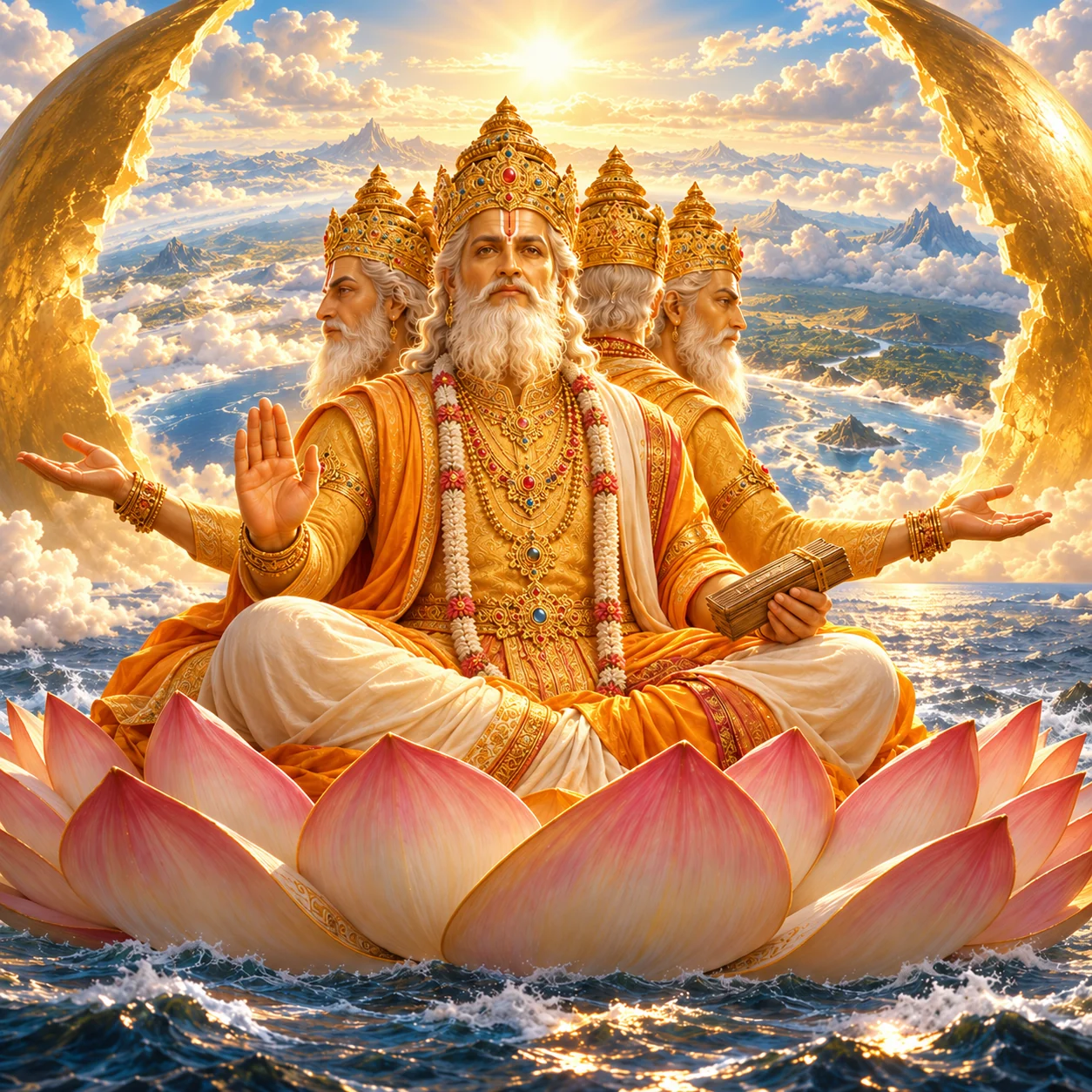
Brahma adalah dewa Hindu yang disebut Sang Pencipta dalam Trimurti bersama Wisnu dan Siwa, dikaitkan dengan penciptaan, pengetahuan, dan Weda, dan digambarkan berkepala empat dan duduk di atas teratai.
Brahma is a Hindu god called the Creator in the Trimurti alongside Vishnu and Shiva, associated with creation, knowledge and the Vedas, and shown with four heads, seated on a lotus.
Kisah dan tradisi
Brahma adalah dewa Hindu yang disebut Sang Pencipta dalam Trimurti, bersama Wisnu dan Siwa. Ia dikaitkan dengan penciptaan segala sesuatu, pengetahuan, dan kitab Weda, dan banyak disebut dalam kisah penciptaan; menurut beberapa Purana ia menciptakan dirinya sendiri dalam janin emas yang disebut Hiranyagarbha. Brahma sering disamakan dengan dewa Weda Prajapati, dan menurut World History Encyclopedia ia juga dikenal sebagai Kakek. Dalam kisah penciptaan, menurut World History Encyclopedia, Brahma muncul dari telur emas kosmis lalu menciptakan baik dan buruk, terang dan gelap, serta dewa, iblis, leluhur, dan manusia. Brahmanda Purana menyebut mula-mula hanya ada samudra abadi, dari mana muncul telur emas Hiranyagarbha tempat Brahma lahir dengan nama Svayambhu. Hukum Manu (terjemahan Bühler) menyebut sang ilahi tinggal setahun penuh di dalam telur itu lalu membelahnya menjadi langit dan bumi. Sumber berbeda tentang asal-usul Brahma: Purana yang berpusat pada Wisnu menyebutnya lahir dari teratai di pusar Wisnu, Purana yang berpusat pada Siwa menyebutnya lahir dari pinggang Siwa, dan sumber lain menyebut Tridewi menciptakannya. Dalam kebanyakan teks Purana ia pencipta sekunder yang kegiatannya bergantung pada dewa atau dewi yang lebih tinggi, dan menurut kitab suci ia fana. Hukum Manu menyebut satu hari Brahman sama dengan seribu zaman para dewa. Brahma biasanya digambarkan sebagai laki-laki berjanggut berkulit merah atau keemasan dengan empat kepala dan empat tangan; keempat kepalanya melambangkan empat Weda dan menghadap empat arah mata angin. Ia duduk di atas teratai dan wahananya adalah hamsa, dan tangannya memegang lambang pengetahuan dan penciptaan, bukan senjata. Menurut World History Encyclopedia, semula ia berkepala lima, dan Siwa memenggal satu kepalanya. Manasara, buku panduan desain kuno, menyatakan arca Brahma hendaknya berwarna emas. Pada masa pasca-Weda Brahma dewa terkemuka dengan sekte sendiri, tetapi menjelang abad ke-7 pengaruhnya surut dan ia dibayangi Wisnu, Siwa, dan Mahadewi. Di India masa kini hanya sedikit kuil yang dipersembahkan kepadanya, yang paling terkenal Kuil Brahma di Pushkar, Rajasthan. Menurut World History Encyclopedia, ia masih dihormati dengan upacara tahunan di Pushkar dan tetap populer di Asia Tenggara, terutama di Thailand dan Bali.
Brahma is a Hindu god known as the Creator in the Trimurti, together with Vishnu and Shiva. He is tied to the making of all things, to knowledge and to the Vedas, and features strongly in creation stories; some Puranas say he created himself inside a golden embryo called the Hiranyagarbha. Brahma is often identified with the Vedic god Prajapati, and according to the World History Encyclopedia he is also known as the Grandfather. In the creation story, according to the World History Encyclopedia, Brahma sprang from the cosmic golden egg and then created good and evil, light and dark, and gods, demons, ancestors and men. The Brahmanda Purana says there was at first only an eternal ocean, from which the golden egg Hiranyagarbha emerged, and Brahma was born in it with the name Svayambhu. The Laws of Manu (Bühler's translation) say the divine one stayed a whole year inside the egg and then divided it into heaven and earth. Sources differ on Brahma's origin: Vishnu-focused Puranas make him born from a lotus in Vishnu's navel, Shiva-focused Puranas from Shiva's waist, and other texts say the Tridevi created him. In most Puranic texts he is a secondary creator whose activity depends on a higher god or goddess, and according to scriptures he is mortal. The Laws of Manu says one day of Brahman equals one thousand ages of the gods. Brahma is usually shown as a bearded red or golden man with four heads and four hands; the heads stand for the four Vedas and face the four directions. He sits on a lotus and his mount is the hamsa, and his hands hold symbols of knowledge and creation, not weapons. According to the World History Encyclopedia he originally had five heads, and Shiva cut one off. The Manasara, an ancient design manual, says a statue of Brahma should be gold in colour. In the post-Vedic period Brahma was a prominent god with his own sect, but by the 7th century his standing had faded and he was overshadowed by Vishnu, Shiva and Mahadevi. Today only a few temples in India are devoted to him, the best known being the Brahma Temple at Pushkar in Rajasthan. According to the World History Encyclopedia he is still honoured with a yearly ceremony at Pushkar and remains popular in Southeast Asia, especially Thailand and Bali.
Konteks budaya
Menurut World History Encyclopedia, dalam sumber Hindu awal seperti Mahabharata Brahma tertinggi dalam triad dewa besar, tetapi dalam Purana yang lebih kemudian ia tidak lagi dipuja dan mitos-mitosnya diserahkan kepada dewa lain, walaupun kedudukannya sebagai pencipta tetap. Di India masa kini ia tidak menikmati pemujaan populer dan jauh lebih kecil kepentingannya daripada dua anggota Trimurti lainnya.
The World History Encyclopedia says that in early Hindu sources such as the Mahabharata Brahma stands highest in the triad of great gods, while in later Puranas worship of him ceases and his myths pass to other gods, though his standing as creator never changes. In contemporary Hinduism he receives no popular worship and counts for substantially less than the other two Trimurti members.
Fakta utama
- Budaya / Culture
- Tradisi Hindu
- Kawasan / Region
- Asia Selatan
- Negara / Country
- India
- Era
- Mentioned with Vishnu and Shiva in the Maitrayaniya Upanishad, probably composed around the late 1st millennium BCE; his sect existed in the post-Vedic period, but by the 7th century he had lost his significance.
- Klasifikasi / Classification
- Deity
- Kemampuan / Abilities
- Penciptaan alam semesta dan makhluk, Penciptaan waktu, Pengetahuan dan Weda
Nama lain / Alternate names
Grandfather, Caturmukha, Caturanana, Astakarna, Ekahamsa, Svayambhu, Phra Phrom, Prah Prohm, Tshangs-pa
Tahukah kamu? / Did you know?
Nama negara Burma diturunkan dari Brahma, dan dalam teks abad pertengahan negeri itu disebut Brahma-desa.
The name of the country Burma is derived from Brahma, and in medieval texts it is called Brahma-desa.