Sockburn Worm
Ringkasan
Sockburn Worm adalah wyvern ganas dalam cerita rakyat Northumbria yang menghancurkan desa Sockburn di Durham sampai dibunuh oleh John Conyers.
The Sockburn Worm is a ferocious wyvern of Northumbrian folklore that laid waste to the village of Sockburn in Durham until John Conyers slew it.
Kisah dan tradisi
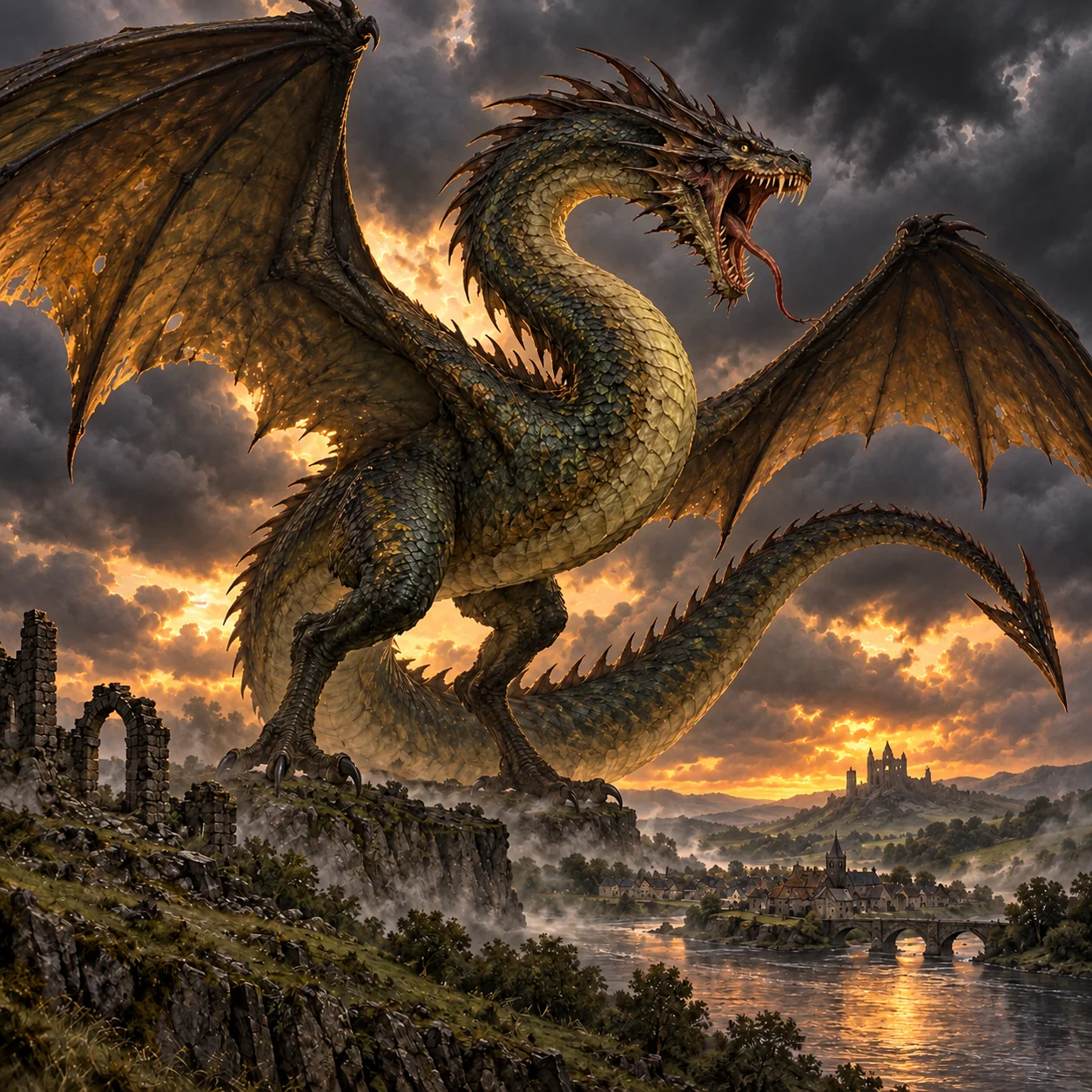
Dalam cerita rakyat Northumbria, Sockburn Worm adalah wyvern ganas yang memporak-porandakan desa Sockburn di Durham, meneror penduduk dan melahap ternak. Kata worm di sini berarti wyvern, yaitu naga bersayap berkaki dua dengan ujung ekor berbentuk mata panah. Pidato upacara menyebutnya 'cacing, naga, atau ular terbang berapi' yang membinasakan laki-laki, perempuan, dan anak-anak, sedangkan buku heraldik awal abad ke-17 menyebutnya wyvern berbisa yang menelan banyak orang. Menurut legenda, pada tahun 1063 Sir John Conyers, kepala keluarganya, membunuh naga itu. Satu versi ringkas menyebut naga itu telah menghantui wilayah tersebut selama tujuh tahun; setelah berdoa di kapel terdekat, Sir John membunuh ular berbau busuk itu dengan falchion-nya, membiarkan tubuhnya di Sungai Tees, dan mengubur sisanya di bawah Grey Stone yang masih terlihat sampai sekarang. Legenda ini melekat pada upacara Conyers Falchion: setiap Uskup Durham yang baru, saat pertama kali menyeberangi Sungai Tees di Croft-on-Tees, diberi pedang abad pertengahan itu disertai pidato tradisional. Kebiasaan itu terhenti pada 1771, pedangnya diserahkan ke Katedral Durham pada 1947, dan upacaranya dihidupkan kembali pada 1984 dengan Wali Kota Darlington sebagai penyerah pedang. Ada dugaan bahwa kisah ini terilhami kapal panjang Viking yang haluannya diukir kepala worm (Ormr), tetapi ada yang mencatat bahwa dugaan itu mengabaikan banyaknya naga dalam cerita rakyat Jermanik. Kisah Sockburn Worm juga hampir pasti mengilhami puisi Jabberwocky karya Lewis Carroll, yang tinggal di Croft-on-Tees.
In Northumbrian folklore the Sockburn Worm was a savage wyvern that ravaged the village of Sockburn in Durham, terrorising locals and devouring livestock. Worm here means a wyvern, a winged two-legged dragon with an arrow-tipped tail. The ceremonial speech calls it a 'worm, dragon or fiery flying serpent' that destroyed man, woman and child, while an early seventeenth-century heraldry book calls it a venomous wyvern that devoured many people. According to legend, in 1063 Sir John Conyers, head of his family, killed the dragon. One summarised version says the dragon had haunted the region for seven years; Sir John, having first prayed in a chapel close by, killed the evil-smelling serpent with his falchion, let its body lie in the River Tees, and buried the remains beneath the Grey Stone, which can still be seen. The legend is bound to the ceremony of the Conyers Falchion: each newly appointed Bishop of Durham, on first crossing the River Tees at Croft-on-Tees, was presented with the medieval sword along with a traditional speech. The custom lapsed in 1771, the sword was given to Durham Cathedral in 1947, and the ceremony was revived in 1984 with the Mayor of Darlington presenting the sword. It has been suggested that the tale was inspired by Viking longships with worm heads (Ormr) carved on their bows, though others note this ignores how common dragons are in Germanic folklore. The Sockburn Worm story was also almost certainly the inspiration for Lewis Carroll's poem Jabberwocky, Carroll having lived in Croft-on-Tees.
Konteks budaya
Nama baik dan garis keturunan keluarga Conyers bertumpu pada naga yang dibunuh leluhur mereka. Di masa pergolakan agama dan sosial, kisah Sockburn Worm paling menonjol di antara cerita naga setempat, dan kisah ini menjadi bagian upacara kepemilikan tanah di Palatinate Durham.
The Conyers family's standing and lineage rested on the dragon slain by their forebear. In a time of religious and social upheaval the Sockburn Worm story stood above the other local dragon tales, and it was woven into the ceremonial tenure ritual of the Palatinate of Durham.
Fakta utama
- Budaya / Culture
- Tradisi Northumbria
- Kawasan / Region
- Eropa
- Era
- slain in 1063 according to legend; recorded in a heraldry book of the early seventeenth century
- Klasifikasi / Classification
- Dragon
- Kemampuan / Abilities
- Bisa, Terbang
Tahukah kamu? / Did you know?
Pedang 'vorpal blade' yang dipakai sang pahlawan dalam puisi Jabberwocky mungkin terilhami Conyers Falchion.
The 'vorpal blade' wielded by the hero of Jabberwocky was probably based on the Conyers Falchion.
Makhluk terkait / Related beings
- Lambton Worm
- Barghest
- Bluecap
- Brown Man of the Muirs
- Dunnie
- Kurcaci Simonside (Simonside Dwarfs)
- Laidly Worm dari Spindleston Heugh (The Laidly Worm of Spindleston Heugh)